Tapeworm Treatment
for Your Healthy Cat
"Even a single flea can infect
your cat with this parasite."
What Exactly is Tapeworm?
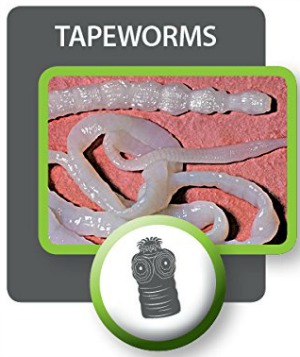
Tapeworm is a parasite that can get into your cat's digestive system and cause potential problems to his or her health. They are also known as Cestodes; the most common is Dipylidium caninum, and it also infects dogs.
This worm has a long, segmented body that can grow to be several inches long, although by the time you see them, they'll probably be a lot smaller.
Segments carrying eggs are passed out of your cat in her feces and sometimes can be found around your kitty's anus.
The eggs are small white moving segments. (They also resemble maggots; just in case you've had the "pleasure" of seeing these disgusting things!)
If you look closely, you can see them pulsing or moving like a flexing muscle. (They're pretty gross!)
After being outside of your feline companion's body for a short while, the parasite segments will dry out and resemble small grains of rice (some people say they look like sesame seeds).
You may also notice some of the dried segments in your kitty's sleeping area. (Hopefully, that isn't your sleeping area, too!)
How Do Felines Get It?
Your kitty can get tapeworm from ingesting a flea that's carrying this parasite's larvae.
Lice carry this worm, too; and felines can also become infected from eating an infected rodent.
In fact, if you discover that your cat has this worm, you can be pretty sure that he or she also has fleas and/or they are also in his or her living environment, whether you see the fleas or not.
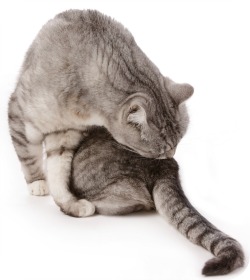 Poor kitty licking at a flea bite
Your feline companion can get this parasite from ingesting one single flea when he is grooming or biting and licking at an area where a flea is biting him.
You don't have to worry about your felines and dogs giving it directly to each other, as they need an intermediate host (the flea) to carry it.
What Will It Do to My Cat's Health?
When your cat or kitten ingests a flea or a rodent infected with tape worm, the head of the parasite attaches to your cat's intestinal wall. It then begins feeding on your cat and absorbing his nutrients.
If left untreated, tapeworms have the potential to debilitate your cat's health.
What is an Effective Cat Tapeworm Treatment?


A very effective drug called Praziquantel is used to get rid of this parasite.
It used to require a prescription from a veterinarian, but now it's available without a prescription and you can find it at online pet pharmacies or at most pet supply stores.
The common name for Praziquantel is "Tapeworm Dewormer." Only one 23 mg. dosage is required to get rid of the worm.
Be sure to get the dewormer for cats (and not dogs).
Unfortunately, the smallest amount you can buy at one time is a bottle of three tablets. However, even this size bottle will most likely be cheaper online than what your veterinarian will charge you per pill.
On the (thankfully rare) occasion when one of my kitty's has had this parasite, I only wasted one of the pills in the bottle of three as I had to give one tablet to each of my two kitties.
Praziquantel is not intended for use in kittens under 6 weeks old. If your kitten has tapeworm, then you might want to look at a natural remedy or, better yet, consult your veterinarian.
If your cat is weak or debilitated, be sure to consult your veterinarian before administering the tablets.
Another Cat Tapeworm Treatment Option
There's another brand on the market called Droncit. They apparently have a spot-on medication (in addition to a pill version), but I haven't been able to find this available at online pet pharmacies in the U.S. However, it does appear to be available in the U.K.
If you absolutely cannot pill your cat, consult with your veterinarian. He or she may be able to give you a spot-on treatment (but it will be cheaper to pill your cat if at all possible).
Dewormer Dosage
I've noticed that some of the bottles of tapeworm dewormer and their wrapping do not tell you the dosage amount! I'm not sure why they are missing this important information.
But anyway, here is the "dosage and administration" information from the manufacturer's website (TradeWinds).
- Cats and kittens (over 6 weeks old) 4 lbs. and under should receive ½ tablet.
- Cats 5 to 11 lbs. should receive 1 tablet.
- Cats over 11 lbs. should receive 1 ½ tablets.
You can give the tablets directly to your kitty or you can crush it up and put it in food. You could also use pill pockets to hide the pill and make your cat think it's a treat, but I haven't personally had too much success with these.
For the cat tapeworm treatment to work, it's important that your cat or kitten gets the full dosage.
So if you put it in food, you have to make sure that all the food is eaten.
Again, don't use this treatment for kittens under six weeks old.
Natural or Homeopathic Treatment
Your kitty can also be treated naturally with a homeopathic remedy. This takes longer than using Praziquantel, but it's a good approach if you want to avoid using conventional chemical drugs on your pet.
In fact, I think (and remember, I'm not a veterinarian) that since this worm is one of the less problematic parasites, a natural remedy can be a more healthy option.
But once you discover these gross little things, you're probably going to want to get rid of them right away; Prazinquantel is effective and quick.
A natural remedy approach can also be safely used as a preventative measure to keep this parasite, as well as hookworm and roundworm, from reoccurring.
You Must Treat for Fleas, too
If your kitty is infected with this worm, you must also treat him or her and his or her surroundings for fleas, or you will just end up having to do the whole treatment cycle again.
Remember, one single flea can infect your feline friend.
Related Topics
Worms in Cats - Here are the other parasites that can infect your kitty.
Worms From Your Cat - Wanna know which parasites can infect humans? Take a look at this article.
Conventional Flea Control Methods - Essential info for getting rid of fleas.
Natural Flea Control Methods - Safely and effectively eliminate fleas.
Common Cat Health Problems - Other health issues to watch out for.
Didn't find what you're looking for? Use this Search Box to find more information.
From Tapeworm Treatment to My Healthy Cat home page
If you suspect your cat is ill, please contact your veterinarian immediately.
The material presented in this site is for informational and entertainment purposes only. It is not intended to replace your veterinarian's advice.
Copyright 2003-2023 © www.myhealthycat.com
Sitemap | Contact Us | About Us | Disclosure | Privacy Policy